One Project Partners with City of Columbus on Participatory Budget Initiative, Giving Residents the Power to Decide City Budget
For most of American history, the municipal budget has been written by a small group of people in rooms that most residents never enter. Council members and department heads negotiate line items, and the finished document gets handed down to the public as something to react to rather than something to shape. The people who actually live with the potholes, the parks, and the streetlights those dollars decide have almost never had a formal say in how the money moves.
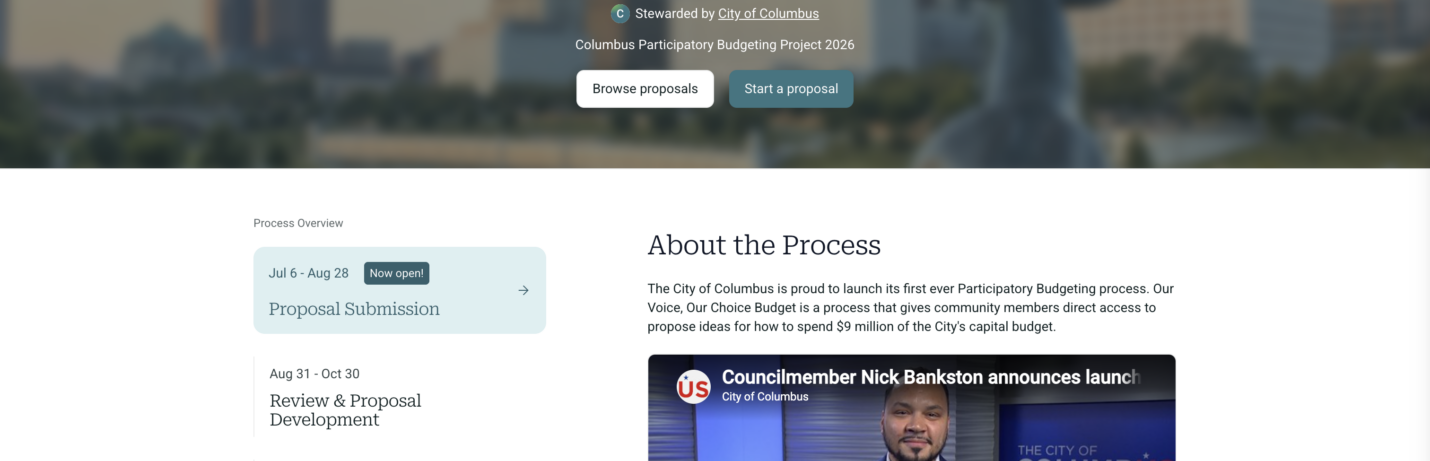
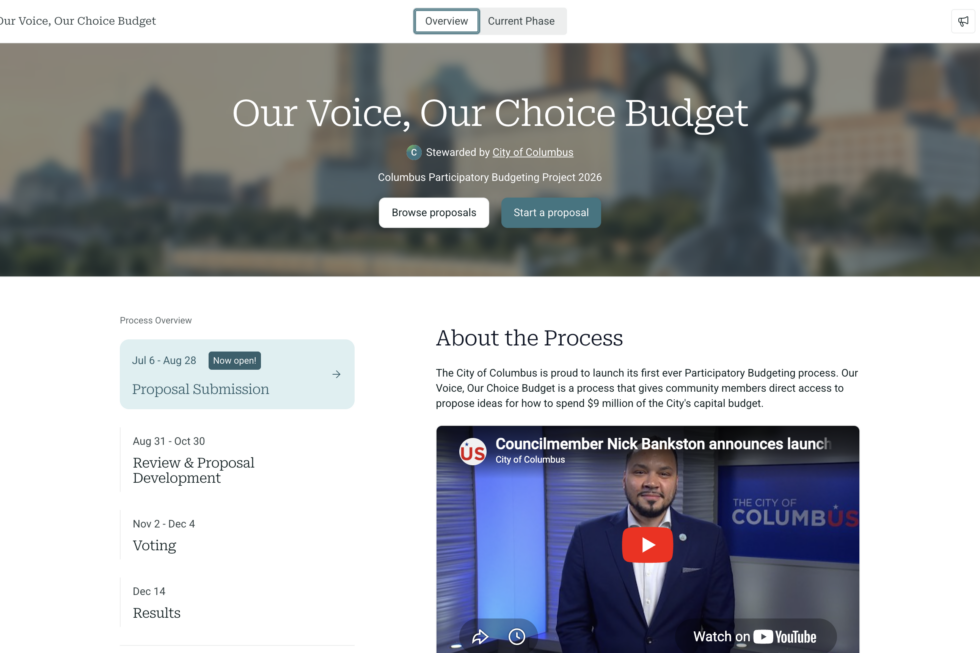
This month, Columbus changed that. The city launched Our Voice, Our Choice Budget, a participatory budgeting program that gives residents direct control over $9 million in city capital funds. Each council district holds $1 million, and for the first time in the city’s history, that money will be spent on what residents themselves decide it should be spent on, whether that’s street lights, extended sidewalks, or facility upgrades for first responders.
From now until August 28, any Columbus resident age 14 or older can submit an idea for a community project. Volunteer budget delegates in each district will then work with city staff to review those submissions and shape the strongest ones into proposals, which will go before the whole city in a vote beginning November 2.
It would be easy to read this as a nice addition sitting on top of an otherwise unchanged system, a feedback mechanism bolted onto business as usual. But, participation isn’t a patch on the process. Participatory budgeting doesn’t patch the old way of deciding how public money gets spent. It replaces it with a different structure entirely, one built on the premise that the people affected by a decision should be the ones who make it. Columbus isn’t asking for input. It’s handing over real authority.
That distinction is the whole reason Common exists. Common is the platform One Project built to make this kind of process operationally possible, and it’s running underneath every phase of the Columbus initiative. Rather than functioning as a comment box that collects feedback and quietly disappears into a bureaucratic process somewhere, Common is the governance layer itself, the infrastructure that makes democratic decision-making over public capital as simple and accessible as anything residents already use day to day.
- Residents can submit ideas publicly or anonymously.
- Submissions are visible across the whole city, not siloed by district.
- An evaluation rubric is built into the platform itself, applied consistently rather than behind closed doors after the fact.
- The platform works in multiple languages and on any device, including SMS, so participation doesn’t depend on owning a smartphone or speaking English fluently.
- At the end of the process, Common produces a public record of every proposal, vote, and funded outcome, closing the loop that most civic engagement efforts leave open.
Columbus is the first city in the country to run an entire participatory budgeting process, from idea generation through the final vote, on a single integrated platform. That detail matters more than it might sound. It’s the difference between participation as a one-time event a city stages every few years and participation as durable infrastructure a city can run again and again, at greater scale and with less friction each time it does.
The evidence is already there.
Skeptics will assume participatory governance is a niche idea with limited appeal. The data tells a different story. Participatory budgeting has already been adopted by at least 64 U.S. cities and counties, moving over $360 million in community-directed funds. The instinct to give people real say over decisions that shape their neighborhoods shows up across the political spectrum, not at its margins.
What’s been missing isn’t public appetite. It’s been the infrastructure needed to make democratic decision-making cheap, legible, and repeatable at the scale a growing city actually requires. That’s the gap Common was built to close, and Columbus is the clearest proof point yet that it can.
Community organizations are hosting brainstorming sessions in neighborhoods across the city over the coming weeks, helping residents translate what they know about their own blocks into concrete proposals. City staff and volunteer delegates are doing the work of turning that knowledge into fundable ideas. Underneath it all, Common is doing the quieter work of holding the whole process together as one coherent system instead of a scattered set of disconnected efforts.
Columbus is one of the fastest-growing cities in the country, and rapid growth usually outpaces a city’s ability to actually hear from the people living through it. Our Voice, Our Choice Budget is a bet that growth and genuine participation don’t have to trade off against each other, provided a city builds the infrastructure to hold both at once.
Let’s go Columbus!